Designed to fatten, not to live
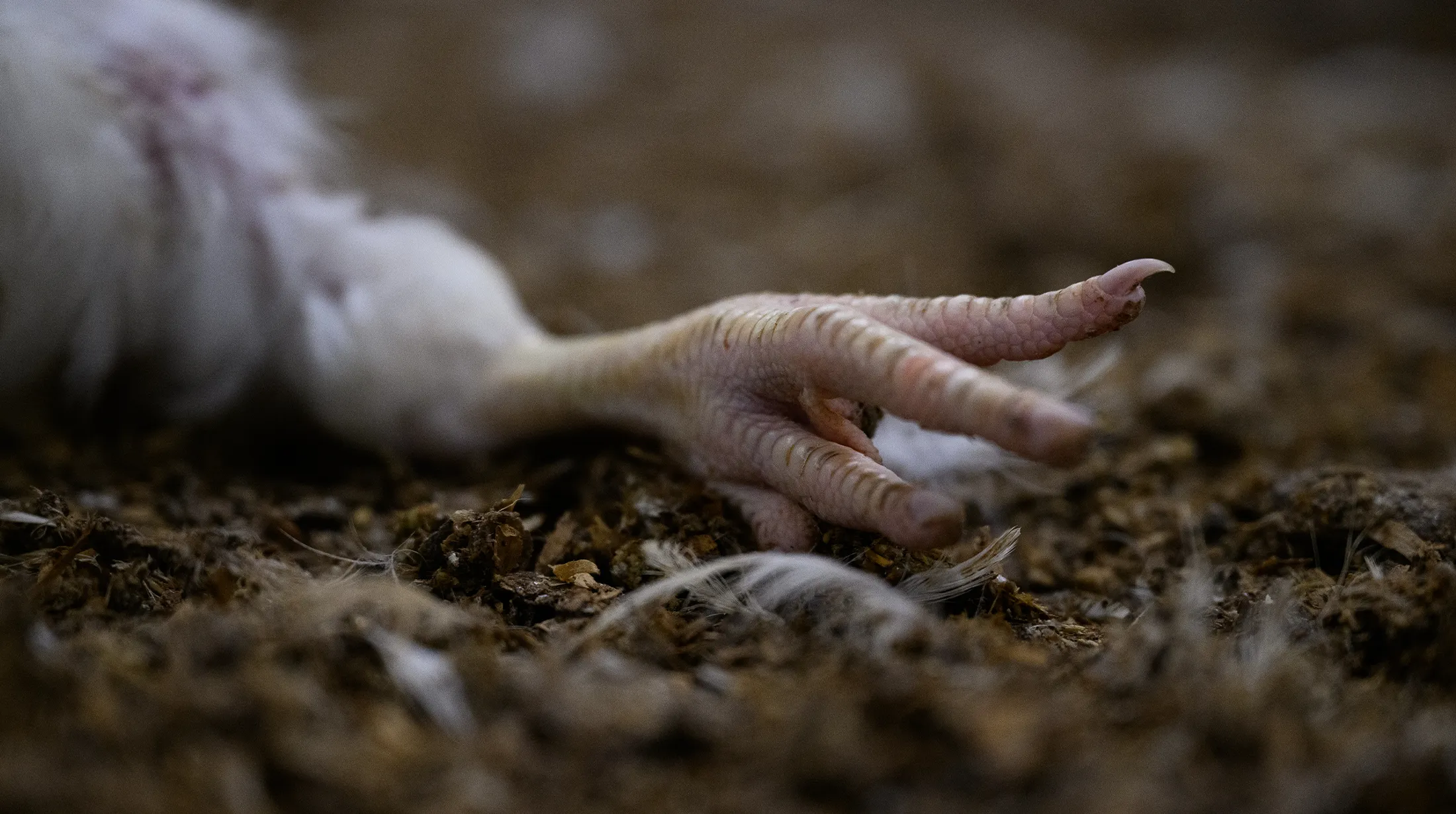
A macro-chicken is not the chicken we used to know. It is an animal genetically redesigned to grow four times faster than 70 years ago, to the point where its own body cannot sustain itself. In just 38 to 42 days —before completing its development— it is already heavy enough to go to the slaughterhouse. Its bones break. Its heart fails. Its legs cannot bear its own weight.
This campaign was born from an undercover investigation into farms in Spain and the European Union. What our cameras recorded is not the exception: it is the system. Every year, more than 810 million of these birds are raised and slaughtered in Spain under conditions that science defines as systematic suffering. The future of chicken welfare depends on legislative changes and public pressure.
Undercover investigation
What no one wants you to see
Every year, more than 810 million of these birds are raised and slaughtered in Spain under conditions that science defines as systematic suffering. AnimaNaturalis, together with the Animal Welfare Observatory and Eurogroup for Animals, investigated. This is what we found.
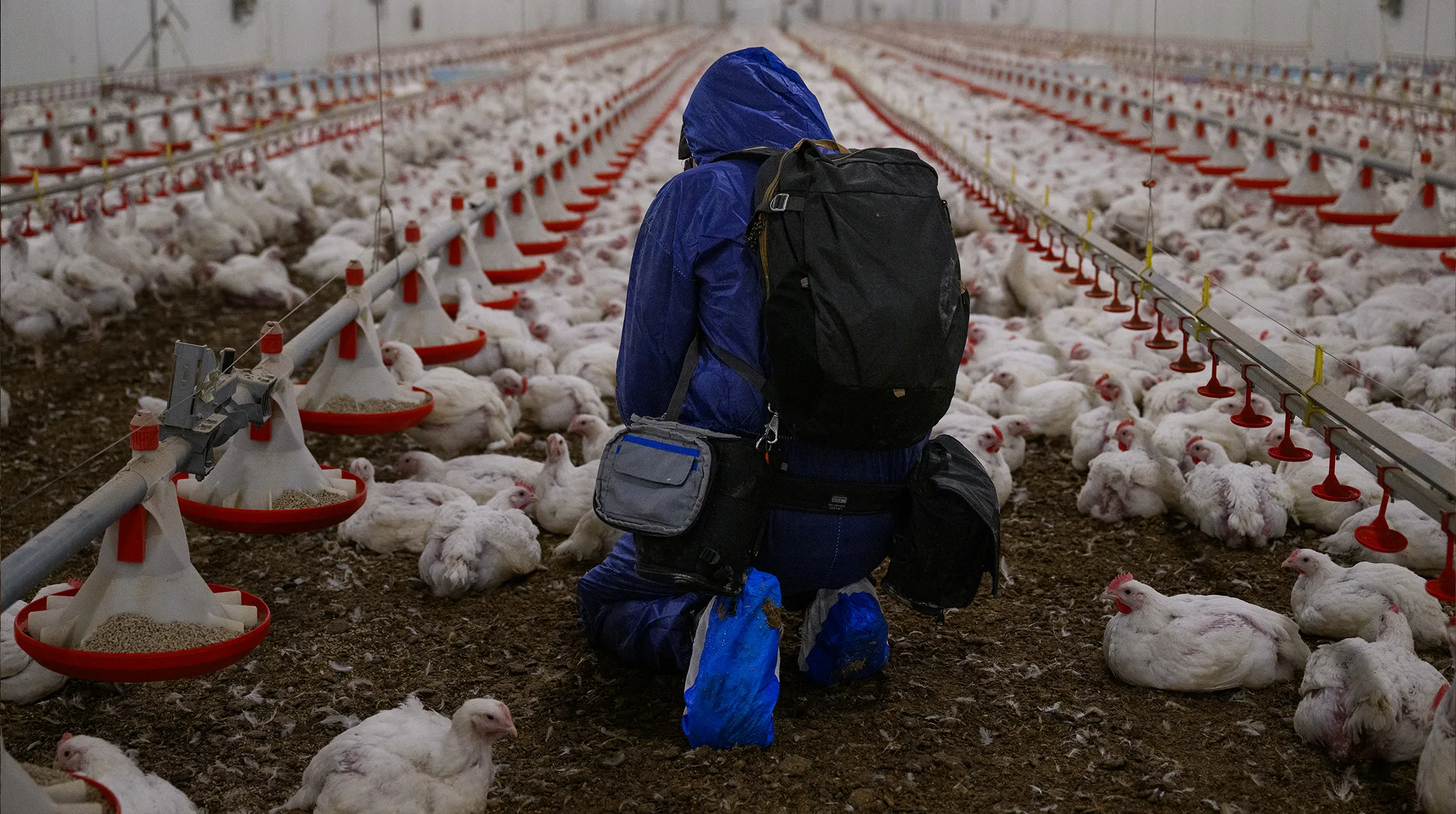
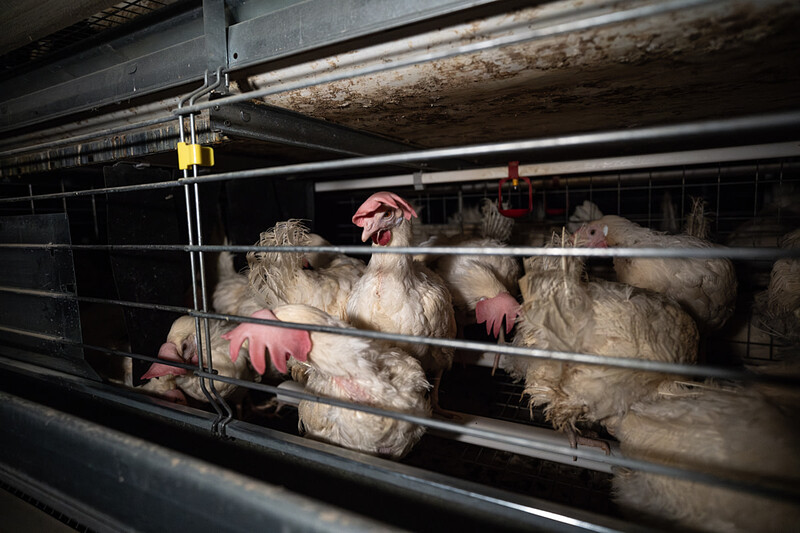
For weeks, our investigators accessed broiler farms at different locations across Catalonia and Castilla-La Mancha. No scripts. No editing. What they recorded is what happens every day, in legal facilities, within current regulations. These are the macro-chickens.

An animal redesigned to suffer
Artificial genetic selection has turned the chicken into a meat-producing machine. In just a few decades, its growth rate has been multiplied by four. The result is an animal whose cardiovascular and skeletal system is unable to support its own muscle mass. Ascites —cardiac failure due to pulmonary hypertension— causes up to 12.4% mortality on farms. The suffering is not an accident: it is built into its own biology.

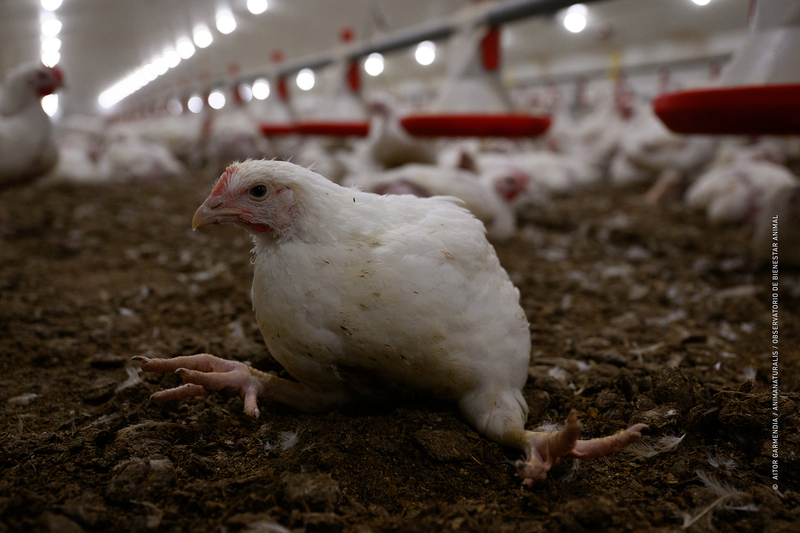
They cannot walk
Between 5.5% and 48.8% of commercial chickens suffer from locomotion disabilities. They spend between 76% and 86% of their lives lying down, not by instinct, but due to physical incapacity and chronic pain. When given analgesics, their activity increases significantly: direct evidence that they live in constant pain. Their legs and respiratory system cannot bear their own weight.

Legal overcrowding, real suffering
European regulations allow densities of up to 42 kg/m². EFSA itself warns that any density above 11 kg/m² prevents basic behaviours: wing-flapping, exploring, preening. Royal Decree 692/2010 allows between 20 and 22 adult chickens in the space of a single parking space. The gap between what science considers acceptable and what the law allows is not a mistake: it is a decision.

Burns, ammonia, pain
Spending almost all their time lying on accumulated excrement, chickens develop burns on their legs and chest. In some systems, moderate to severe lesions affect 71.5% of birds. Ammonia in the sheds —at concentrations above 15 ppm— irritates mucous membranes, damages eyes and promotes serious respiratory diseases.

Horror in plain light
In industrial sheds, the light cycle is controlled by a timer programmed to maximise feed consumption: between 18 and 23 hours of artificial light per day. The logic is simple: an awake chicken eats, and a chicken that eats grows. Legislation requires a minimum of 6 hours of darkness, but enforcement is practically non-existent. The science is clear: balanced light cycles reduce locomotor injuries and cardiovascular mortality.
What the labels don't tell you
chickens slaughtered per year in Spain alone European leaders, second only to Poland.
is the entire lifespan of a macro-chicken From incubator to slaughterhouse. A traditional hen lives 15 years.
die on the farm before reaching the slaughterhouse in Spain alone More than 112,000 birds every day — without appearing on any label.
faster they grow today than in 1957 Through artificial genetic selection. Their bodies cannot sustain themselves.
EFSA 2024 data — Spain / European Union
You've seen it. Now you can't ignore it.
What this investigation documents does not happen on illegal farms or in exceptional conditions. It happens every day, on an industrial scale, within the bounds of the law. And it happens because the majority of people have never been able to see it.
Signing is essential. Every signature tells the industry and legislators that #MacroChickens is no longer a secret. If you can also support AnimaNaturalis's investigation financially, you will be making it possible for us to keep going where they don't want us to go.

Days 1–14:
Born alone. And already starting to die.
Chicks are born in massive industrial incubators and transported on conveyor belts from the very first second of life, with no mother or natural warmth. Mortality in this first phase is high: dehydration, infections and thermoregulation failures. Drinkers are installed at the height of the bird's outstretched neck, not to make hydration easier: to prevent water from wetting the litter and generating bacteria. The weakest simply do not make it.

Days 15–28:
The only "quiet" week.
Between days 15 and 28, mortality drops below 0.5%. This is the phase the industry calls "feed efficiency": the animals eat non-stop under programmes of up to 20 hours of artificial light. But the damage begins here in silence. If ventilation is not perfect —and it rarely is at this density— the ammonia from excrement already starts to burn the legs: the pododermatitis that in later stages becomes serious lesions.

Days 29–42:
The body collapses.
In the final stretch, mortality surges again: between 1.5% and 2% of birds die because their own body gives out. The heart and lungs have not grown at the same rate as the muscle mass. Density reaches 42 kg/m². When slaughter arrives, workers grab the chickens by the legs at high speed, causing fractures. A percentage arrives dead at the slaughterhouse —what the industry calls DOA, Dead on Arrival— without anyone seeing it on any label.

The antibiotic use that persists
The use of antibiotics to accelerate growth has been banned in the EU since 2006. However, in 2024 Spain used 29.5 tonnes of antimicrobials on chickens: more than double the European average adjusted for biomass (93.1 mg/kg in Spain versus 46.1 mg/kg in the EU). Their use no longer fattens: but it remains necessary to keep alive animals raised in unsustainable conditions.

41 million never reach the slaughterhouse
In Spain, 5.6% of farmed chickens —around 41 million animals per year— die on the farm before they can be slaughtered, due to pathologies derived from their own genetic design. That is more than 112,000 deaths per day from induced biological fragility. This figure does not appear on the label of any product. Every signature tells the industry and legislators that this is no longer a secret.
We demand immediately
We call for an end to factory farming. We can do without the exploitation of animals and we work to uncover the cruel reality that the meat, egg and dairy industry hides from us.
With particular urgency we demand:
That regulations be amended so that farm facilities allow animals to develop their natural behaviour without restriction.
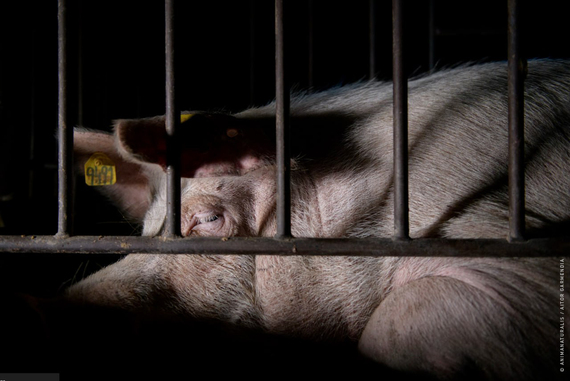
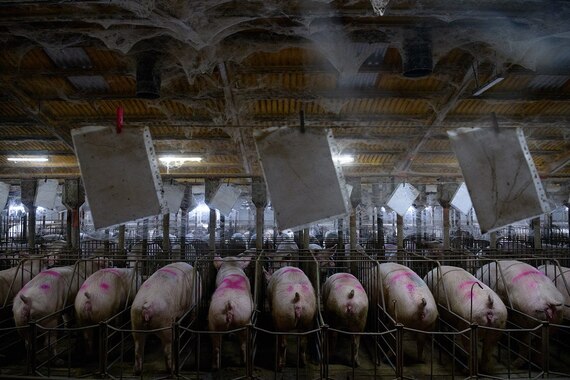
A ban on cages in all farms, regardless of species or production cycle.
A ban on tail and beak trimming, tooth extraction and castration without anaesthesia.
An immediate ban on the live shredding of male chicks as a culling method on farms.
A European label that informs consumers about the production system animals are subjected to for meat, dairy and derivatives, thus preventing consumer fraud.
Specific animal welfare legislation for species that currently lack it, such as rabbits, turkeys and calves.
Veterinary care focused on the welfare of each animal as an individual and not solely on ensuring the survival and productivity of the group on the farm.
The feeding of animals on farms must take into account not only fattening or survival, but the proper nutrition of the animals. It is impossible to speak of welfare if they are not offered a balanced diet suited to their organism, not merely a high-calorie feed.
Farm animal sanctuaries find themselves in a legal void and caught between two Ministries
04 mayo 2026
Two decrees in progress, two ministries in conflict and no legal category for sanctuaries. While the Government updates — fifty years late — the regulations on establishments that house animals, those who rescue cows, pigs and hens from industrial farming still have no name in the law.
Norway eliminates fast-growing chickens and sets the standard for a new reality of european animal welfare
20 febrero 2026
The Norwegian poultry sector commits to eradicating breeds selected for extreme growth speed by 2027, rescuing more than 70 million animals per year from decades of systematic suffering. Why does the European Union continue to look the other way?
EFSA confirms systematic suffering of turkeys on EU farms
19 febrero 2026
A 300-page report from the European Food Safety Authority concludes that current confinement systems fail to meet the basic needs of more than 240 million turkeys per year. How is it possible that in 2026 these animals still lack any specific European law to protect them?
The voice of 300 million caged animals reaches the Court of Justice of the European Union
05 febrero 2026
On 5 March 2026, the EU Court of Justice will hold an unprecedented public hearing on the European Commission’s failure to comply with the European Citizens’ Initiative “End the Cage Age.” Can European justice compel the Commission to honour its 2021 promise and finally put an end to cages on farms?
The European Commission plans to betray 1.4 million citizens by abandoning the cage ban
20 octubre 2025
A leaked draft of the European Commission’s 2026 Work Programme reveals an intention to omit the long-promised legislative proposal to end the use of cages in farming. AnimaNaturalis is joining the End the Cage Age coalition to mobilize letters and mass actions ahead of the programme’s official adoption on October 21.
Activists and politicians demand a Cage-Free Europe
25 junio 2025
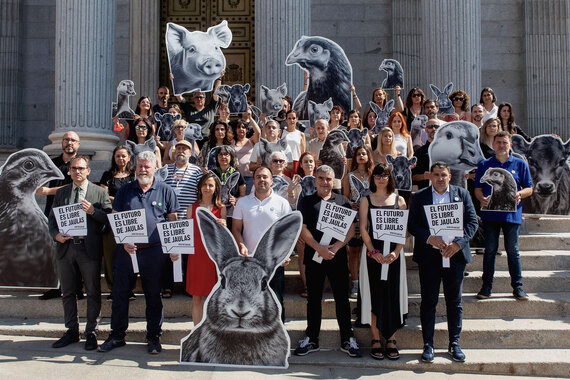
This morning, AnimaNaturalis and its allies from the End The Cage Age coalition gathered dozens of activists and parliamentarians in front of the Congress of Deputies to demand authorities immediately fulfill Europe’s promise to ban cages on farms.
Support our campaign
Your contribution will allow us to continue this campaign until the last consequences.